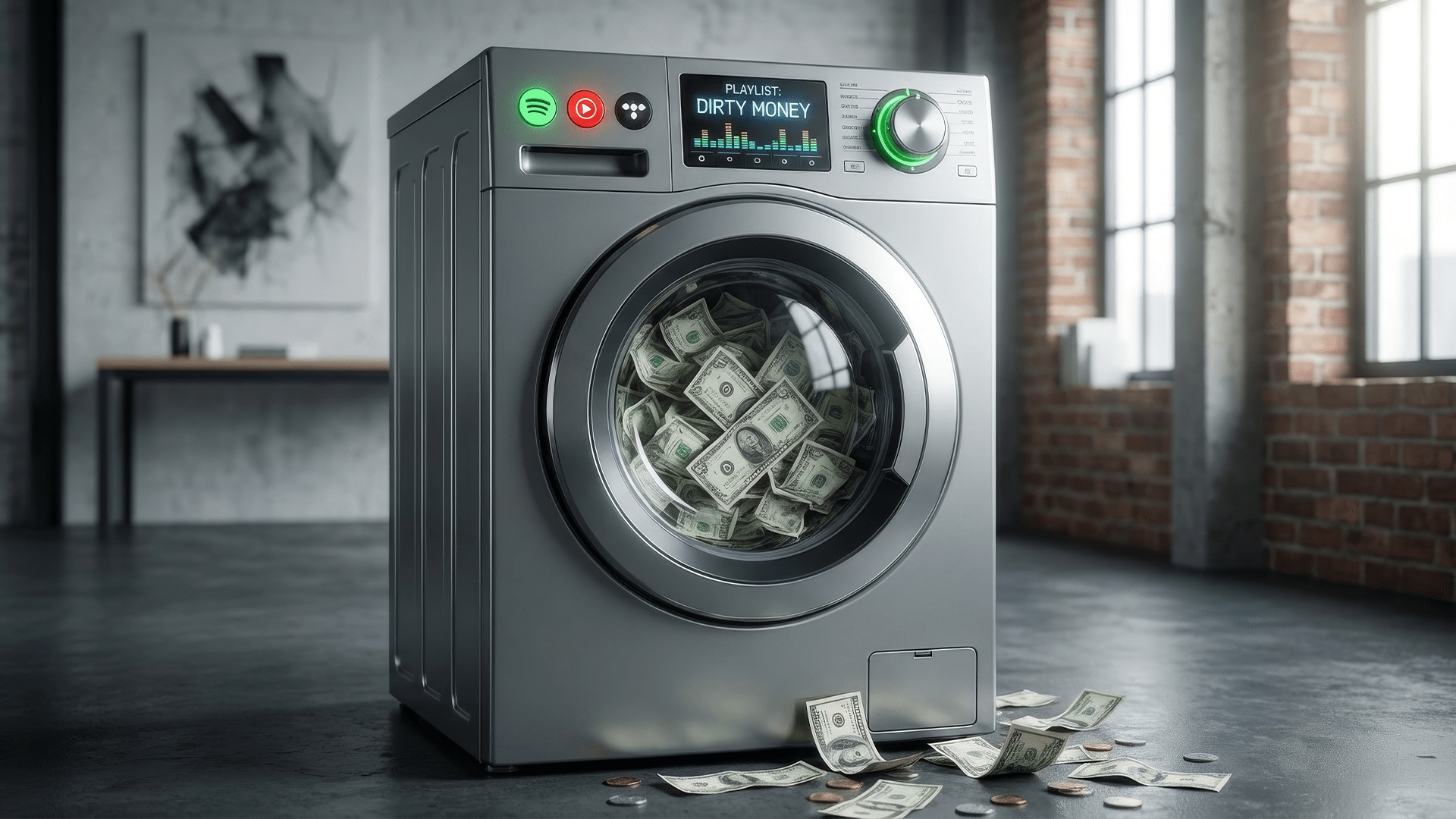

Is the music industry a laundromat for criminal organizations? The short answer is yes and we aren’t talking about them cleaning their underwear or panties. They’re cleaning their dirty hard cold cash. What does this illegal activity look like in relation to the music industry?
Money laundering in the music industry often exploits concerts, royalties, and digital platforms to disguise illicit funds. Criminals use inflated contracts, fake ticket sales, and manipulated streaming numbers to make dirty money appear legitimate.
COMMON METHODS OF MONEY LAUNDERING
Concerts & Ticket Sales
Criminals organize concerts with artificially high ticket prices or buy large volumes of tickets themselves. This makes illegal money appear as legitimate revenue from fans attending shows.
Streaming Manipulation
Fraudsters funnel illicit funds into fake streaming farms that repeatedly play songs. The royalties generated look like legitimate income from popular music. This is especially effective because streaming platforms pay per play and also pay according to an artist’s percentage of the market share on any given streaming platform.
Therefore, monitoring fraudulent streams can be a daunting undertaking and depending on the artist that’s being monitored, the enforcement against fake streams may not always be in the best interest of the streaming company’s profit margins.
Inflated Contracts & Ghost Artists
Criminal organizations create shell companies or partner with record labels who willing or unwilling participate in a scheme to sign artists to be overvalued for recording or management contracts. The payments made to the artist or label disguise illegal money as legitimate business expenses.
It may be difficult to call into question catalogs bought or sold at suspiciously inflated values, since catalog pricing is subjective and easy to exploit.
Additionally, sometimes, “ghost artists” are created by criminal enterprises. Ghost artists are musicians who don’t actually exist. These artists who don’t publicly perform or truly release music can mysteriously still generate “royalties or advances which serve as helpful tools to provide a cover for laundering.
Music Catalog & Publishing Rights
Criminals purchase or sell music catalogs and publishing rights at manipulated prices. The transactions make illicit money appear as legitimate investments or sale proceeds. Since catalog valuation is subjective, it’s easy to inflate or deflate prices to move money.
Merchandise & Ancillary Sales
Fake or exaggerated sales of merchandise. For example, shirts, posters and vinyl can facilitate the injection of dirty money into the business as supposed consumer purchases.
International Transfers & Shell Companies
Money is routed through multiple jurisdictions using shell companies tied to music labels, distributors, or promoters. This layering obscures the origin of funds.
What Makes the Music Industry an Ideal Environment
The legal complexity of the royalty payout structure. Payments flow through multiple intermediaries making auditing very challenging. Additionally, global digital payments which consist of cross border transactions can be tricky to monitor. Opaque contracts or deals between artists, promoters, and record labels often lack transparency.
Successful money laundering operations in the music industry thrive on cash heavy events, subjective valuations, and legal loopholes. From inflated concert ticket sales to fake streams, criminals exploit the industry’s glamour and complexity to wash illicit funds into seemingly legitimate revenue streams.
Real world examples of how money laundering looks in the music industry
Criminals have used fake streaming, cartel linked concerts and manipulated royalties to disguise illicit funds. Here are a few examples.
Fake Streaming Fraud
In 2024 a North Carolina self-described musician by the name of Michael Smith, was indicted for creating hundreds of thousands of AI-generated songs and using bots to rack up fake streams. The scheme generated over $10 million dollars in royalties, which prosecutors say was a cover for wire fraud and money laundering. This was the first U.S. criminal case involving artificially inflated streaming numbers, showing how digital platforms can be exploited.
Other investigations have revealed that criminals have been using Spotify and other streaming platforms to launder money. The method involves uploading tracks, then using illicit funds to pay for fake streams, making the money appear as legitimate royalty income. Streaming payouts are automated and global; this tactic is difficult to detect.
Mexican Cartel Linked Concerts
Ricardo Hernández Medrano, known as “El Makabélico”, an artist tied to the Cartel del Noreste (formerly Los Zetas), was sanctioned by the U.S. Treasury. His concerts and performances were allegedly used to launder cartel money, with profits funneled through ticket sales and event revenues. This demonstrates how live shows can serve as fronts for moving illicit cash into the legitimate economy.
The Red Flags
Money laundering in the music industry isn’t just hypothetical; it has been prosecuted in U.S. courts and linked to organized crime internationally. From fake AI-generated streams to cartel-backed concerts, the industry’s mix of glamour, cash flow, and digital royalties makes it a prime target for laundering schemes.
In the U.S. case against Michael Smith (2024), investigators noticed hundreds of thousands of streams coming from a small number of IP addresses. Legitimate hits usually show diverse geographic listening, so concentrated, repetitive streams raised suspicion.
In cartel linked concerts in Mexico, tickets were sold at extremely high prices, but venues were often half-empty. Authorities realized the money wasn’t coming from fans but was cartel cash disguised as ticket revenue.
The Ability to Evade Detection by Authorities Has Been Reduced
Money laundering activities in the music industry often leave statistical fingerprints. Whether it’s streams that don’t match audience demographics, concerts that don’t match attendance, or contracts that don’t match industry norms. All of these anomalies uncover the schemes.
With drug cartels now being designated as narco-terrorist organizations by the U.S. federal government, the increased law enforcement actions will inevitably include adjacent investigations into other criminal enterprises that may have drug cartel affiliations.
The trail of evidence will lead to the discovery of more money laundering activities being conducted in the music industry by these organizations. The reduction of criminal bad actors in the industry means the adoption of a safer, more transparent business model for many years to come. The future is bright, lighting a path leading to healthy and fair competition for all.